

Uncategorized
Uncategorized
How Much Does Umrah Cost from Bangladesh in 2026?
By the ITS Holidays Team — Umrah & visa specialists. Last updated: 4 November 2026.
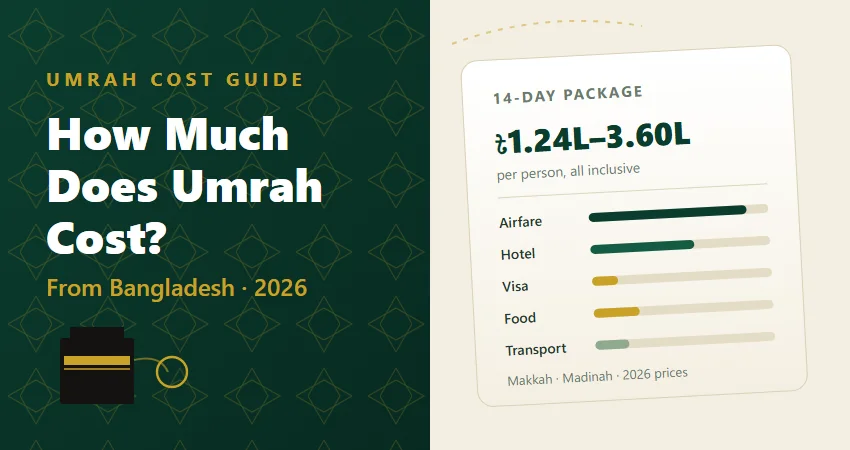
A 14-day Umrah from Bangladesh in 2026 costs between BDT 1,24,000 and BDT 3,60,000 per person on a package, with most families landing between BDT 1,45,000 and BDT 2,15,000. The spread is not random: it comes from four things you actually control — how far your Makkah hotel is from the Haram, which month you fly, how many nights you stay, and whether the visa, insurance and ground transport are bundled or bought one at a time.
This guide breaks the total down line by line, using 2026 prices from licensed Bangladeshi agencies, Saudia’s own published fares, Saudi Arabia’s official visa portal and the Haramain railway’s fare table. Every figure below is sourced, in riyals where the price is set in riyals, and converted at BDT 33.16 per SAR.
On this page
- Short answer: what a 14-day Umrah costs
- Package prices by comfort tier and duration
- Airfare: the line that swings most
- Visa, insurance and the 2026 Nusuk rule
- Hotels: what distance from the Haram really costs
- Food and transport inside Saudi Arabia
- Package or DIY? A like-for-like comparison
- Sample budget: a family of three, 14 days
- Seven ways to cut the cost without cutting corners
- Costs pilgrims forget to budget
- Questions Bangladeshi pilgrims ask most
Short answer: what a 14-day Umrah costs
Per person, twin or triple sharing, all-inclusive (return airfare, visa, hotels in Makkah and Madinah, airport and intercity transport, ziyarah):
| Comfort tier | Typical 2026 starting price | What you get |
|---|---|---|
| Economy | BDT 1,24,000 – 1,39,000 | 3-star hotel 700 m–1 km from the Haram, shared transport, group ziyarah |
| Standard | BDT 1,29,000 – 1,75,000 | 3–4-star hotel 300–700 m out, breakfast, Bangla-speaking guide |
| Premium | BDT 1,88,000 – 2,15,000 | 4–5-star hotel 200–400 m out, meals, direct Saudia flights |
| Luxury / VIP | BDT 3,25,000 – 3,60,000+ | 5-star Haram-view hotel, private car, personalised ziyarah schedule |
Two things surprise first-time pilgrims. First, a 14-day economy package can cost less than a 7-day one sold in the same season, because the 7-day departures use peak-date flights while the 14-day blocks are bought in bulk. Second, the gap between economy and premium — roughly BDT 1 lakh per person — is almost entirely hotel distance. You are not paying more for a better Umrah; you are paying for fewer steps to the Haram.
Package prices by comfort tier and duration
Duration moves the price less than people expect, because airfare dominates the fixed side of the bill and hotel nights dominate the variable side. These are published starting prices from licensed agencies in Dhaka, checked in November 2026. Treat them as the floor of the market, not a quote for your dates.
| Duration | Published starting price (per person) | Notes |
|---|---|---|
| 7 days | BDT 1,35,000 (economy) – 1,95,000 (top tier) | Usually 3 nights Makkah, 3 nights Madinah; peak-date flights push the floor up |
| 14 days | BDT 1,24,000 (economy) – 2,15,000 (premium) | Best value per night; the most popular length from Bangladesh |
| 15 days | BDT 1,45,000 – 2,15,000 | Standard and premium tiers; extra Madinah nights |
| Ramadan, 14–21 days | BDT 1,90,000 – 3,25,000 | Iftar and sehri included; hotel rates 2–3× off-peak |
Add roughly BDT 40,000–70,000 per person to any of these if you want a room to yourself. A family of three sharing a triple pays the per-person rate shown; a couple wanting privacy pays a single-supplement equivalent.
Airfare: the line that swings most
Return airfare from Dhaka accounts for roughly half the cost of an economy package. Saudia’s own Dhaka–Jeddah fare page lists round-trip economy fares from about SAR 3,300 (around BDT 1,09,000) for off-peak dates, with the next tier around SAR 3,714 (BDT 1,23,000). Biman Bangladesh operates direct Dhaka–Jeddah and Dhaka–Madinah services, and Saudia and Flynas both carry large Umrah blocks out of Dhaka.
What actually changes the number:
- Season. Ramadan and the weeks before it are the most expensive window of the year. Flying after Hajj, or in the quieter months, is where the real saving sits.
- Booking lead time. Group blocks are bought months ahead. A seat added to a departure that is already 80% full is priced as a retail seat, not a group seat — usually BDT 20,000–40,000 more.
- Direct versus one-stop. A direct Dhaka–Jeddah flight saves a connection and costs more; a one-stop via Colombo, Kuala Lumpur or Muscat can be BDT 15,000–25,000 cheaper at the cost of 4–8 hours.
- Arrival airport. Landing in Jeddah means a 1–1.5 hour transfer to Makkah. Landing in Madinah puts you 20 minutes from Masjid an-Nabawi and lets you do Madinah first — often the calmer, cheaper sequence.
Visa, insurance and the 2026 Nusuk rule
The official Umrah visa fee shown on Saudi Arabia’s national platform is SAR 300, about BDT 9,950 at today’s rate, and the Ministry of Hajj and Umrah treats mandatory pilgrim insurance as part of that issuance rather than a separate line. Bangladeshi passport holders are not on the tourist e-visa list, so the Umrah visa is the route — applied for through a licensed operator, not directly by the pilgrim.
In practice agencies quote the whole visa line at BDT 17,000–23,000. The difference is service fees, biometric enrolment handling through the Saudi Visa Bio app, and insurance variations. Some providers quote up to BDT 38,000; anything materially above that for visa-only processing deserves an itemised explanation.
One structural change matters more than the fee: under the current Nusuk-linked rule, a visa cannot be issued without a confirmed, Nusuk-verified hotel booking and pre-booked ground transport. “Visa only” no longer exists as a standalone product. That is why every legitimate 2026 quote bundles accommodation and transfers with the visa — and why a suspiciously cheap visa offer usually means someone is preparing documents that will not pass.
Hotels: what distance from the Haram really costs
Accommodation is the largest controllable cost, and distance is the dial. Off-peak rates in Makkah, per room per night:
| Zone | Walk to Masjid al-Haram | Off-peak rate per room | Per person, twin share, 8 nights |
|---|---|---|---|
| Haram / Clock Tower | Under 300 m, some linked by walkway | From SAR 705 (~BDT 23,400) | ~BDT 93,500 |
| Central 2nd zone | 300–700 m | SAR 400–700 | ~BDT 53,000–92,800 |
| Budget 3-star (Misfalah, Ajyad) | 700 m–1.5 km | SAR 150–400 | ~BDT 19,900–53,000 |
| Outer, shuttle-served | 2 km+ | SAR 55–150 | ~BDT 7,300–19,900 |
Booking.com’s own city average for 3-star Makkah hotels sits near SAR 246 a night, which tells you the budget tier is real and not a marketing story. Madinah is consistently cheaper than Makkah for the same grade — often 30–40% less — so if you can add a night, add it in Madinah.
Ramadan multiplies everything: expect 2–3× off-peak rates on ordinary Ramadan nights, and 4–6× during the last ten nights. That single fact explains most of the gap between a quiet-season Umrah and a Ramadan one.
Food and transport inside Saudi Arabia
Food is cheaper than most Bangladeshi pilgrims budget for. A cafeteria or street meal runs SAR 5–20, an Al Baik meal SAR 15–30, a food-court plate SAR 20–45, and a hotel buffet SAR 60–80. A realistic modest budget is SAR 40–80 per person per day — roughly BDT 1,330–2,650, or BDT 18,600–37,100 across a 14-day trip. Zamzam water is free inside both Harams, so drinking water costs nothing.
Ground transport, one way:
- Jeddah airport → Makkah hotel: SAR 200–350 by taxi or Careem (~BDT 6,600–11,600 per car), surging toward SAR 500 at peak arrival times.
- Makkah → Madinah by Haramain high-speed train: official economy base fare SAR 162 plus 15% VAT, about SAR 186 (~BDT 6,170); business SAR 455 (~BDT 15,100). Book on the operator’s own site — resellers quote materially above the official fare.
- Makkah → Madinah by intercity bus: SAR 85–100 (~BDT 2,800–3,300), roughly 6.5 hours.
- Madinah station → Masjid an-Nabawi: SAR 40–80; there is no free shuttle.
Package or DIY? A like-for-like comparison
Assembling the trip yourself looks cheaper until you price it honestly. Below is a 14-day trip, one person, twin sharing, off-peak, using the midpoint of each sourced range:
| Line item | Low (BDT) | High (BDT) |
|---|---|---|
| Return airfare Dhaka–Jeddah | 1,10,000 | 1,23,000 |
| Visa, insurance, agent fee | 10,000 | 23,000 |
| Makkah hotel, 8 nights, twin share | 26,500 | 53,100 |
| Madinah hotel, 5 nights, twin share | 12,400 | 24,900 |
| Haramain train, Makkah–Madinah | 6,200 | 6,200 |
| Airport transfer (shared) | 2,300 | 4,000 |
| Food, 14 days | 18,600 | 37,100 |
| Local transport and ziyarah | 5,000 | 9,900 |
| SIM, Zamzam, small gifts | 4,000 | 8,300 |
| Subtotal | 1,95,000 | 2,89,500 |
| Contingency reserve (~10%) | 21,400 | 31,800 |
| Total, self-booked | 2,14,400 | 3,18,400 |
Compare that with the BDT 1,24,000–2,15,000 market range for a 14-day package, and the conclusion is uncomfortable but clear: at the economy end a package is meaningfully cheaper than DIY, because agencies buy hotel nights and air seats at group rates a retail traveller cannot reach. DIY wins only when you are flexible on dates, staying with family in Jeddah, or travelling beyond 21 days. If you want to assemble the pieces yourself, read our Umrah package booking guide first — it sets out exactly what a legitimate quote must contain.
Sample budget: a family of three, 14 days
Two adults and one child, standard tier, one triple room, off-peak departure from Dhaka:
- Package (3 × BDT 1,55,000): BDT 4,65,000
- Food outside the package, 14 days: BDT 55,000–80,000
- Ziyarah extras, gifts, Zamzam, SIM: BDT 25,000–40,000
- Contingency reserve (10% of total): BDT 55,000–60,000
- Realistic total: BDT 6,00,000–6,45,000 for the family
Two levers matter for families specifically. A child sharing the parents’ room is usually charged at 50–70% of the adult rate, sometimes less under the age of two — ask explicitly, because the discount is rarely volunteered. And a triple room is almost always cheaper than two doubles; if your children are young, it is the single biggest saving available. Our guide to choosing the best Umrah package for your family covers room configurations and what to get in writing.
Seven ways to cut the cost without cutting corners
- Shift the month, not the hotel. Moving from Ramadan to the weeks after Hajj typically saves more than downgrading your hotel by two grades.
- Stay one zone further out. Going from 300 m to 900 m roughly halves the nightly rate. A 12-minute walk four times a day is a real cost — decide honestly whether you will walk it.
- Add nights in Madinah, not Makkah. Same grade, 30–40% cheaper per night.
- Take the bus one way. The Haramain train is fast and worth it once; the bus at SAR 85–100 is fine for the return leg if your schedule is loose.
- Buy into the group block early. The cheapest seats in any departure are sold 3–5 months out, and they do not come back.
- Eat where residents eat. A cafeteria breakfast and an Al Baik dinner costs under SAR 40 a day against SAR 80–160 at hotel buffets.
- Ask for an itemised quote. An agency that cannot break out visa, insurance, hotel nights, flights and transport separately is pricing on opacity, and you cannot compare it to anything.
Costs pilgrims forget to budget
- Single supplement if you travel alone and will not share — BDT 40,000–70,000.
- Vaccination certificates, if your record is not current — a few thousand taka, but they can hold up a visa.
- Passport renewal if validity is under six months from travel. This stops applications outright.
- Overweight baggage on the return leg, once Zamzam and gifts are packed. Weigh your bags at home.
- Card fees abroad. Always pay in SAR, never in taka, when a terminal offers the choice — the conversion markup is typically 3–5%.
- Mobile roaming. A local SIM costs a fraction of a week of roaming.
Questions Bangladeshi pilgrims ask most
How much does the cheapest possible Umrah from Bangladesh cost in 2026?
Around BDT 1,24,000–1,35,000 per person for a 14-day economy package from Dhaka, twin or triple share, off-peak, with a 3-star hotel 700 m–1 km from the Haram. Below that you are usually looking at a shorter trip in low season, a shuttle-served hotel 2 km or more out, or a quote with something material missing.
Why is a 7-day package sometimes more expensive than a 14-day one?
Because 7-day departures cluster around peak dates where airfare is highest, while 14-day blocks are negotiated in bulk for less contested dates. Duration is a weak price signal; season and hotel zone are strong ones.
Is the visa fee included in the package price?
In every standard 2026 package, yes — the Nusuk rule effectively forces it, since a visa cannot be issued without a confirmed hotel and transport booking. Visa-only processing, where quoted, should land around BDT 17,000–23,000 and must be itemised.
How much cash should I carry beyond the package?
Budget SAR 40–80 per person per day for food and incidentals, plus a one-off SAR 300–500 for gifts and local transport. For 14 days that is roughly BDT 25,000–40,000 per person, plus a 10% reserve.
Can I pay in instalments?
Most Dhaka agencies take a deposit to hold a seat and the balance before visa submission — typically 30–50% down. Ask what happens to the deposit if the visa is refused; that clause matters more than the deposit size.
Next step: get a quote built on your dates
Everything above is a market range for November 2026. Your actual number depends on your month, your room configuration and how far ahead you book — which is exactly what a written quote should show you, line by line. The Umrah packages from Bangladesh page lists current departures by tier and duration, and you can contact the ITS Holidays team for a quote with your travel month and group size. If you are still deciding whether to go through an agency at all, read the benefits of booking through an Umrah travel agency in Bangladesh before you compare prices — the difference between two quotes is usually in what is not included.
Sources: Saudi national platform — Umrah Visa e-service (SAR 300) · Saudia Dhaka–Jeddah fares · Saudi Arabia Railways Haramain fare table · Nusuk · Booking.com Makkah 3-star city average · published starting prices from licensed Bangladeshi Umrah agencies. All figures checked November 2026. Currency conversions at BDT 33.16 per SAR.